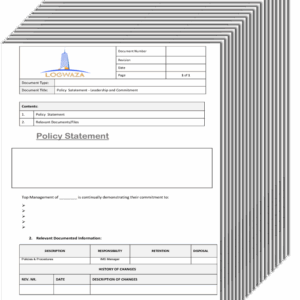

Description
Our ISO 9001 & 45001 Combo Pack integrates certification of both two of the world’s premier quality standards being ISO 9001 (2015) as well as 45001.
Benefits of ISO 9001:2015:
Improved Customer Satisfaction: By focusing on consistent quality and customer needs, you can enhance satisfaction and build stronger relationships.
Benefits of ISO 45001:2018:
Reduced Workplace Injuries and Illnesses: By implementing a robust health and safety management system, you can create a safer work environment and prevent incidents.
ISO 9001
Description
By starting with a comprehensive document starter pack, organizations can establish a strong foundation for their ISO 9001 QMS and achieve their quality objectives.
- Quality policy
- Quality objectives
- Criteria for the evaluation and selection of suppliers
In addition to our documents package, the following Mandatory documented information is required
Mandatory Records:
- Monitoring and measuring equipment calibration records
- Records of training, skills, experience and qualifications and proof.
- Product/service requirements review records.
- Record about design and development outputs review
- Records about design and development inputs
- Records of design and development controls
- Records of design and development outputs
- Design and development changes records
- Characteristics of product to be produced and service to be provided
- Records about customer property
- Production/service provision change control records
- Record of conformity of product/service with acceptance criteria
- Record of nonconforming outputs
- Monitoring and measurement results
- Internal audit program
- Results of internal audits
- Results of the management review
- Results of corrective actions
- *Records marked with* are not mandatory when the relevant clause is excluded
Non-mandatory documents
The following Non-mandatory documents (procedures) can be used for ISO 9001 implementation and are sometimes regarded as necessary. You might find that an auditor request to see the documented information concerning these clauses. It also demonstrates that you do understand and apply the standard requirements in the specific sections.
The ISO 9001:2008 standard required six procedures, but ISO 9001:2015 does not have any required procedures. Every organization needs to determine which procedures are needed to implement the QMS scope successfully in order to avoid nonconformity in the processes.
Although ISO 9001:2015 cites no mandatory procedures in the requirements; however, organizations may need to include them to ensure that processes occur as planned, in which case the following comes in very handy:
- Procedure for determining context of the organization and interested parties clauses 4.1 and 4.2
- Procedure for addressing risks and opportunities
- Procedure for competence, training and awareness
- Procedure for equipment maintenance and measuring equipment
- Procedure for document and record control
- Sales procedure
- Procedure for design and development
- Procedure for production and service provision
- Warehousing procedure
- Procedure for management of nonconformities and corrective actions
- Procedure for monitoring customer satisfaction
- Procedure for internal audit
- Procedure for management review
Do you need a quality manual?
While a quality manual is not required by ISO 9001:2015, it is just so much easier to give your auditor a summary in short of what happens within the organization and how the Quality Management System is integrated and implemented within the processes of the organization.
Sometimes it is necessary to create a manual in response to a customer requirement, or the manual can serve to showcase the mandatory documents of the QMS – scope, quality policy, quality objectives, and supplier selection criteria – into one document, also containing explanations of how clauses of the standard is applied within the processes of the business.
Our document kit makes it very easy to establish and implement a DIY Quality Management System with our help.
ISO 45001
The main objective of the documentation requirements is designed to:
- Ensure consistency of the processes and provide evidence that procedures are applied
- Record keeping compliancy will ensure a robust, effectively documented Management System, easy to maintain and achieve certification/s.
By starting with a comprehensive document starter pack, organizations can establish a strong foundation for their ISO 45001 OHSMS and create a safer work environment.
In addition to our documents package, the following Mandatory documented information is required
- Scope of the OH&S management system
- OH&S policy
- Responsibilities and authorities within OH&SMS
- OH&S process for addressing risks and opportunities
- Methodology and criteria for assessment of OH&S risks
- OH&S objectives and plans for achieving them
- Emergency preparedness and response process
Mandatory records
- OH&S risks and opportunities and actions to address them
- Legal and other requirements
- Evidence of competence
- Evidence of communications
- Plans for responding to potential emergency situations
- Results on monitoring, measurements, analysis and performance evaluation
- Maintenance, calibration or verification of monitoring equipment
- Compliance evaluation results
- Internal audit program
- Internal audit report
- Results of management review
- Nature of incidents or nonconformities and any subsequent action taken’ including their effectiveness
- Results of any action and corrective action, including their effectiveness
- Evidence of the results of continual improvement
Non-mandatory documents
In addition to mandatory documentation, non-mandatory documents might come in handy in relevant areas where documents can help to manage processes. includes the following procedures:
- OH&S Manual
- (Procedure for determining context of the organization and interested parties)
- Procedure for consultation and participation of workers
- Procedure for hazard identification and assessment
- Procedure for identification of legal requirements
- Procedure for communication
- Procedure for document and record control
- Procedure for operational planning and control
- Procedure for change management
- Procedure for monitoring, measuring and analysis
- Procedure for compliance evaluation
- Procedure for internal audit
- Procedure for management review
- Procedure for incident investigation
- Procedure for management of nonconformities and corrective actions
- Procedure for continual improvement
The main objective of the documentation requirements is designed to:
- Ensure consistency of the processes and provide evidence that procedures are applied
- Record keeping compliancy will ensure a robust, effectively documented Management System, easy to maintain and achieve certification/s.